

IN THIS ARTICLE
What causes glare?
Discomfort glare and disability glare
Why position and viewing direction matter
How optics and shielding help control glare
What does UGR tell us?
Glare in architectural lighting
Questions about glare
#UNDERSTANDING LIGHT
Glare occurs when light within the field of view makes seeing uncomfortable or more difficult. It is not simply a question of having too much light. Luminance, contrast, position, optics and the direction of view all influence whether a light source causes glare.
THE ESSENTIALS
A bright luminaire, daylight through a window or reflected light from a surface can all contribute.
Good glare control therefore depends not only on the luminaire, but also on its position, optics, surroundings and where people are likely to look.
WHAT CAUSES GLARE?
Glare is closely related to luminance, the light coming from a surface or source towards the eye.
A bright source does not exist in isolation. What matters is its relationship to the rest of the visual field. A luminaire may feel comfortable against a bright background but much more prominent against darker surroundings.
Several factors can influence glare:
luminance of the light source
contrast with surrounding surfaces
size of the apparent light source
position within the field of view
viewing direction
optics and shielding
reflected light from glossy or bright surfaces
This is why glare cannot always be judged from the light output or wattage of a luminaire alone.
DISCOMFORT GLARE AND DISABILITY GLARE

In architectural interiors, discomfort glare is often the aspect considered when evaluating luminaires and their placement.
Glare is generally distinguished in two ways.
Discomfort glare causes visual discomfort without necessarily making objects more difficult to see.
Disability glare reduces the ability to see objects or details, even when it does not necessarily feel uncomfortable.
The distinction matters because a lighting installation can be visually uncomfortable before it actually impairs visibility.
Sensitivity to glare also increases with age, as the eye scatters more light. This is not reflected in UGR, but it is relevant in hotels, healthcare settings and other spaces used by older people.
WHY POSITION AND VIEWING DIRECTION MATTER
The same luminaire can produce a different glare experience depending on where it is installed and where the viewer is positioned.
A bright source close to the normal line of sight is generally more noticeable than one positioned further away from it. The direction people face while working, moving through a space or looking at displays therefore becomes part of the lighting design.
This is particularly relevant around screens, workstations, circulation routes, reception areas and other places where viewing directions can be anticipated.
Glare control is therefore not only about selecting the right product. It also involves deciding where the luminaire is placed and what people will see from the positions they actually occupy.
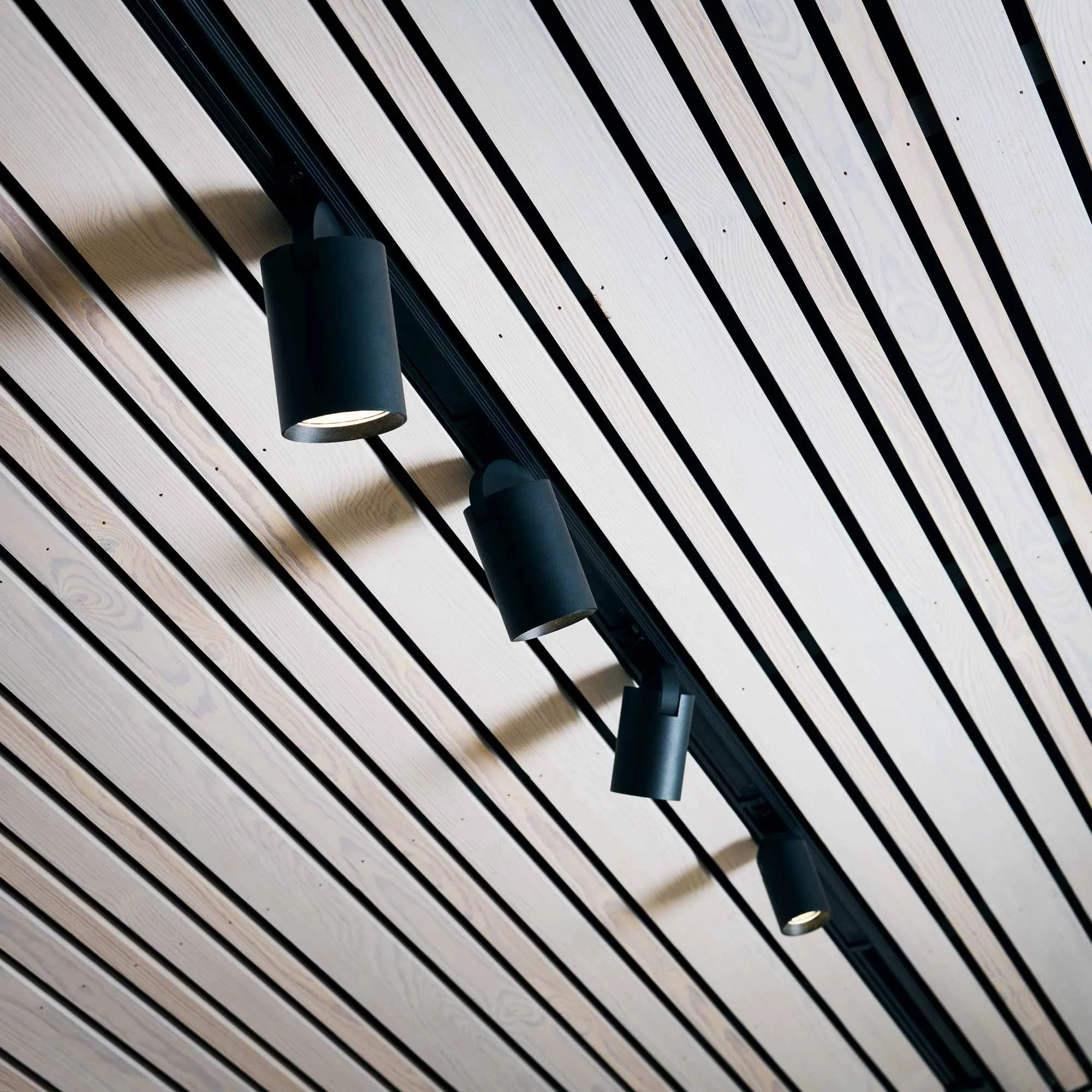
LIK Lighting works with appropriate solutions to control glare in lighting design.
HOW OPTICS AND SHIELDING HELP CONTROL GLARE
The optical design of a luminaire influences how its light leaves the fitting and how visible the bright light-emitting surface is from different angles.
Reflectors, lenses, louvres, baffles and recessed light sources can all be used to shape the distribution or shield direct views of high-luminance areas.
Beam direction matters as well. A spotlight aimed towards the viewer may create glare even when the same product performs comfortably from another position.
The appropriate solution depends on the application. Controlling glare should not simply mean eliminating contrast or making every surface equally bright.
WHAT DOES UGR TELL US?
Unified Glare Rating (UGR) is a method used to evaluate discomfort glare from indoor lighting installations.
The calculation considers factors including the luminance and apparent size of glare sources, their position in relation to the observer and the background luminance. This means UGR is related to the lighting installation and viewing conditions, not simply an isolated property of a luminaire.
A single UGR value on a datasheet is calculated for a standardised reference room. It is a useful basis for comparing luminaires, but the actual value in a project depends on the room’s dimensions, surfaces, luminaire layout and viewing positions.
UGR values are commonly used when assessing lighting for workplaces and other indoor environments.
UGR is expressed in steps – typically 16, 19, 22, 25 and 28 – where lower values indicate less discomfort glare. EN 12464-1 sets maximum values for different tasks: for example UGR 19 for reading, writing and computer work, and UGR 16 for technical drawing.
UGR values are useful, but they do not describe every glare situation. The CIE has found that conventional UGR calculations tend to underestimate discomfort from LED luminaires with highly non-uniform luminous surfaces. The method is also not designed for very small or very large sources, such as wallwashers or luminous ceilings, and it does not assess reflections in screens or glossy surfaces.
GLARE IN ARCHITECTURAL LIGHTING
Glare control is part of balancing visibility, contrast and architectural expression.
A completely uniform visual environment is not necessarily desirable. Brighter and darker areas can establish hierarchy, reveal form and direct attention. The challenge is to create useful contrast without introducing distracting or uncomfortable sources within the field of view.
This requires looking at the complete situation: luminaires, surfaces, materials, positioning, viewing direction and the activities taking place in the space.
The question is therefore not simply Is this a low-glare luminaire?
It is also Will this lighting arrangement be comfortable from the places where people actually see it?
Questions about glare
Is glare simply caused by too much light?
No. Glare depends on luminance, contrast, position and viewing conditions. A relatively small but bright source can cause discomfort even when the overall light level in the room is not particularly high.
What is UGR in lighting?
UGR stands for Unified Glare Rating. It is a method for evaluating discomfort glare from indoor lighting installations under defined conditions.
What UGR value is recommended for offices?
EN 12464-1 sets a maximum UGR of 19 for reading, writing and computer work. Lower values indicate less discomfort glare.
Does a low UGR luminaire guarantee glare-free lighting?
Not on its own. Glare depends on the installation, room conditions, luminaire position and viewing direction as well as the characteristics of the luminaire. The UGR value on a datasheet is calculated for a standardised reference room, so the result in a real project can be higher or lower.
Can reflected light cause glare?
Yes. Reflections in screens, glossy desks or polished floors can create high luminance in the field of view. UGR does not assess this, so reflected glare must be handled through luminaire positioning, luminance limits towards screens and the choice of surface finishes.
Published: 28.092026
Related Knowledge
Colour rendering: CRI, R9 and how we see colour
Colour rendering describes how a light source affects the appearance of colours compared with a reference light.
Understanding colour temperature
How two different characteristics of light influence the way colours, materials and interiors are perceived.
What is architectural lighting design?
How light levels, visual comfort, materials and technical requirements become part of the architecture.
Planning a project?
