
IN THIS ARTICLE
What reflectance tells you
Why walls and ceilings matter
Matt and glossy surfaces
Revealing colour and texture
What to check before specification
Questions about light and surfaces
#UNDERSTANDING LIGHT
Walls, ceilings, floors and furnishings influence how light moves through a room. Their reflectance, colour and finish affect perceived brightness, contrast and the appearance of materials.
The same lighting arrangement can therefore produce different results when the surfaces change.
THE ESSENTIALS
Surfaces are part of the lighting design
Reflectance describes the proportion of incident light that a surface reflects. Surface finish determines how that reflected light is distributed.
Both matter when selecting materials and planning lighting. A pale matt wall and a polished dark surface interact with light in very different ways.
WHAT REFLECTANCE TELLS YOU
In lighting design, luminous reflectance describes how much of the visible light reaching a surface is reflected, usually expressed as a percentage. A reflectance of 70% means that the surface reflects 70% of the incident luminous flux under the stated conditions.
Pale finishes generally reflect more light than dark ones. But reflectance alone does not tell you whether a surface will look evenly bright or show a sharp reflection of a luminaire. The finish, lighting direction and viewing position also matter.
A useful distinction is between how much light a surface reflects and where that light goes.
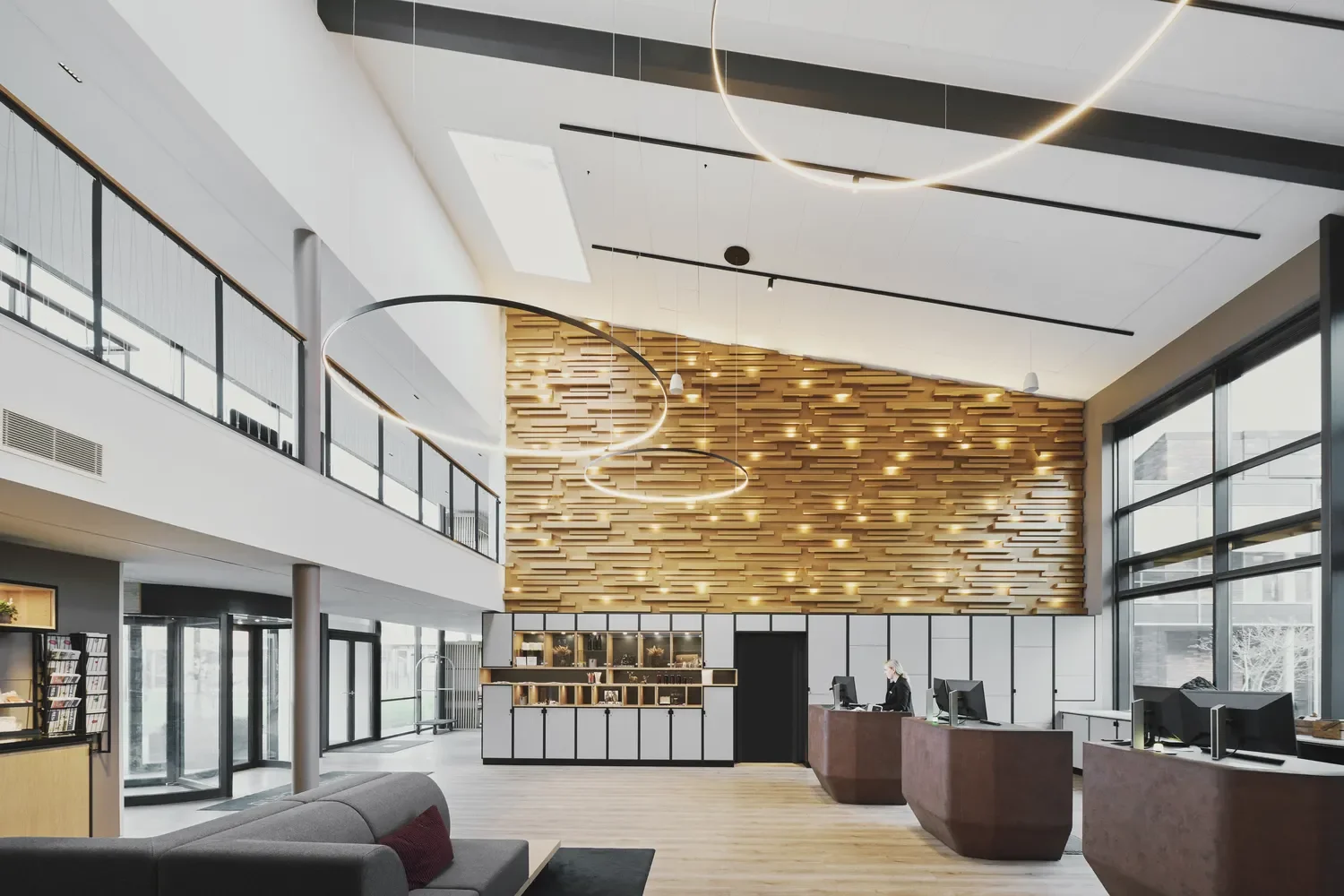
A lighting design project example - Himmerland Resort
WHY WALLS AND CEILINGS MATTER
Large surfaces influence both the distribution of light and the impression of the room. Illuminated walls can make a space feel brighter and more open, while lighting concentrated on the floor can leave the surrounding architecture relatively dark.
As a reference, EN 12464-1 recommends reflectances of around 0.7–0.9 for ceilings, 0.5–0.8 for walls and 0.2–0.4 for floors in workplaces. Many interiors deliberately fall outside these ranges, which is exactly when the lighting needs to be planned around the actual materials.
Indirect lighting relies on ceilings or walls to reflect light back into the space. A low-reflectance finish returns less light, so a scheme developed around a pale ceiling may perform differently if that ceiling becomes dark timber or a dark acoustic finish.
Dark materials can still be central to the design. The lighting needs to work with them, using appropriate distribution and contrast rather than simply increasing output everywhere.
MATT AND GLOSSY SURFACES
Matt surfaces scatter reflected light across many directions. Glossy surfaces produce a more directional reflection, sometimes showing a recognisable image of the light source. Many finishes combine both behaviours.
This means a dark polished surface can show a bright reflection even though it reflects relatively little light overall. A pale matt surface can reflect more light without producing the same concentrated highlight.
Reflections can reveal a material’s character, but they can also cause glare or obscure detail. Check glossy desks, polished stone and display surfaces from the positions people will actually occupy. Luminaire placement and aiming are part of that assessment.
REVEALING COLOUR AND TEXTURE
The direction of light changes how texture is perceived. Grazing light, falling across a surface at a shallow angle, creates shadows that emphasise relief in brick, stone or timber. It can also reveal unwanted unevenness and joints. More diffuse light tends to soften these effects.
Surface colour matters too. Light reflected from a strongly coloured wall can introduce a colour cast onto nearby surfaces. Where material appearance is important, assess samples together under the intended lighting.

LIK Lighting coordinates the material palette and lighting design before key decisions are fixed.
WHAT TO CHECK BEFORE SPECIFICATION
Coordinate the material palette and lighting design before key decisions are fixed:
Reflectance: use manufacturer data – often given as Light Reflectance Value (LRV) on a scale of 0–100 – or measured values where available, and identify assumptions in calculations.
Finish: distinguish between matt, satin, gloss and textured surfaces.
Lighting direction: decide whether the aim is to reveal texture, illuminate a surface evenly or create highlights.
Viewing positions: check reflections from seated, standing and circulation positions.
Material changes: review the lighting if significant finishes change.
A physical mock-up is particularly useful for glossy or textured materials. Calculations can assess light levels, while testing helps establish whether the intended material expression and visual comfort are achieved.
Questions about light and surfaces
Is reflectance the same as gloss?
No. Reflectance describes the proportion of light reflected. Gloss concerns the directional character of the reflection. A surface can have high reflectance and a matt finish.
Do dark interiors always need more light?
Not everywhere. Dark surfaces return less light to the room, but the response depends on the task and design intent. Targeted lighting and carefully chosen illuminated surfaces may be more appropriate than raising the overall light level.
Can changing a wall or ceiling finish affect a lighting calculation?
Yes. Surface reflectance influences interreflected light. A significant material change should prompt a review, particularly where the design relies on indirect lighting.
Is grazing light suitable for every wall?
No. It emphasises texture, including imperfections. Use it where that effect supports the architecture, and test the actual finish before committing to the detail.
Published: 28.092026
Related Knowledge
What causes glare in lighting?
How luminance, contrast, optics and luminaire position influence visual comfort.
Colour rendering: CRI, R9 and how we see colour
Colour rendering describes how a light source affects the appearance of colours compared with a reference light.
Understanding colour temperature
How two different characteristics of light influence the way colours, materials and interiors are perceived.
Planning a project?
